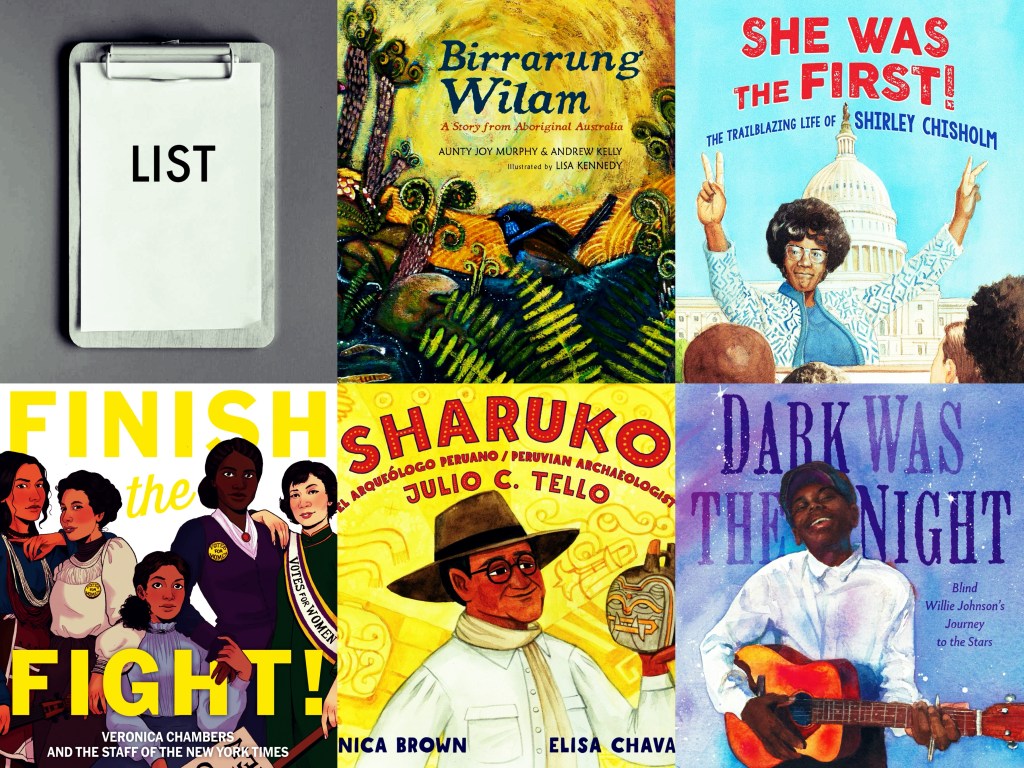
Although I don’t have kids, I ADORE children’s books. I was an avid reader as a child, and I still fondly remember many of my favorites (Peter Spier’s Oh, Were They Ever Happy! anyone? Or Animalia by Graeme Base – his illustrations were phenomenal). I was originally going to focus this website on nonfiction books for adults, but there are a lot of amazing nonfiction books for kids – and I’M HERE FOR IT! Although we’re nearing the end of August, so many great children’s books have been released this month, many of them about real people, places, and events. So, here’s my round-up of five nonfiction children’s books released this month that I’m looking forward to checking out. If you have little ones, I suggest you take a look at these.
Birrarung Wilam: A Story from Aboriginal Australia, by Aunty Joy Murphy and Andrew Kelly, Illustrated by Lisa Kennedy (Released August 4, 2020)
Blurb from the publisher: “Yarra Riverkeeper Andrew Kelly and Aboriginal Elder of the Wurundjeri people Aunty Joy Murphy join to tell the Indigenous and geographical story of Melbourne’s beautiful Yarra River — from its source to its mouth and from its prehistory to the present day. The writing dazzles with poetic descriptions of the trees, plants, and wildlife that thrive in harmony along the iconic waterway. Lush and vibrant acrylic paintings from Indigenous illustrator Lisa Kennedy make the mighty Yarra come to life — coursing under a starry sky, drawing people to its sunny shores, mirroring a searing orange sunset. Jewel-like details in the illustrations offer opportunities for discovery on every page. As gorgeous and powerful as the river itself, this stunner invites all to come to Wilam: home.” Ages 6 to 9, Grades 1 to 4.
Why I’m excited about it: Having visited Melbourne several years ago (and marveled at the beauty of the Yarra River), I’m so pleased to see this gorgeous book hit shelves in the US this month. There is so much beauty in Australia, and children’s books that explore the beauty in both nature and indigenous culture (and how they intersect) is something that we all need to see more often. The book also serves as a fabulous introduction to the Woiwurrung language, structured to allow readers to work out meanings of the indigenous words using context, the illustrations, and the glossary. In its starred review from Publisher’s Weekly, they stated, “It’s a lovely, immersive introduction to a language, and a closely observed view of the Australian natural world”.
She Was the First!: The Trailblazing Life of Shirley Chisholm, by Katheryn Russell-Brown, Illustrated by Eric Velasquez (Released August 4, 2020)
Blurb from the publisher: “Even as a young child growing up in the 1920s, Shirley Chisholm was a leader. At the age of three, older children were already following her lead in their Brooklyn neighborhood. As a student at Brooklyn College, Shirley could outtalk anyone who opposed her on the debate team. After graduating, she used her voice and leadership to fight for educational change. In community groups, she stood up for the rights of women and minorities. Her small stature and fiery determination often took people by surprise. But they listened. In 1964, Shirley took her voice and leadership to politics, becoming the first Black woman elected to the New York State Assembly, and in 1968, the first Black woman elected to Congress. Then in 1972, she became the first Black woman to seek the presidency of the United States. She pushed for laws that helped women, children, students, poor people, farm workers, Native people, and others who were often ignored. She fought for healthcare. She spoke up for military veterans. She spoke out against war. Shirley Chisholm, a woman of many firsts, was an unforgettable political trailblazer, a candidate of the people and catalyst of change who opened the door for women in the political arena and for the first Black president of the United States.” Ages 6 to 12, Grades 1 to 6.
Why I’m excited about it: Everyone should know about Shirley Chisholm! This book seems like it will be a great introduction for kids to understand the role of women (especially black and other women of color) in politics in the United States. With the recent nomination of Kamala Harris as the first Black woman on a major-party presidential ticket (YES!), knowing the story of Shirley Chisholm will help children understand how history has brought us to this moment – and the courage that it took for all the women of color who came before – – – who put themselves out there and tried to make change. Recent articles on Chisholm and others who trail-blazed into US politics have been featured in the news lately, like this one from The Conversation and this one from Vox.
Finish the Fight!: The Brave and Revolutionary Women Who Fought for the Right to Vote, by Veronica Chambers and The Staff of The New York Times (Released August 18, 2020)
Blurb from the publisher: “Who was at the forefront of women’s right to vote? We know a few famous names, like Susan B. Anthony and Elizabeth Cady Stanton, but what about so many others from diverse backgrounds—black, Asian, Latinx, Native American, and more—who helped lead the fight for suffrage? On the hundredth anniversary of the historic win for women’s rights, it’s time to celebrate the names and stories of the women whose stories have yet to be told. Gorgeous portraits accompany biographies of such fierce but forgotten women as Yankton Dakota Sioux writer and advocate Zitkála-Šá, Mary Eliza Church Terrell, who cofounded the National Association of Colored Women (NACW), and Mabel Ping-Hua Lee, who, at just sixteen years old, helped lead the biggest parade in history to promote the cause of suffrage. FINISH THE FIGHT will fit alongside important collections that tell the full story of America’s fiercest women. Perfect for fans of GOOD NIGHT STORIES FOR REBEL GIRLS and BAD GIRLS THROUGHOUT HISTORY.” Ages 8 to 12, Grades 3 to 7.
Why I’m excited about it: With this month’s celebration of the 100th Anniversary of the passage of the 19th amendment, this book couldn’t be more timely. Also, I LOVE that it tells the story of women who haven’t been featured at the forefront of the suffragist movement – these are the stories we need to hear. You can learn more by listening to this recent interview that NPR did with Veronica Chambers, the author. Although women won the right to vote 100 years ago, the fight for gender equality continues. As Chamber’s said in her interview with NPR, “I think anyone who’s a woman in this country knows that we don’t get equal pay [or other treatment that would support equality, like childcare]… there’s a lot of that still hanging in the balance… I think that the question of women’s equality is far from complete in this country.” Here’s hoping the next generation can be inspired to finish the fight!
Sharuko: El Arqueólogo Peruano Julio C. Tello / Peruvian Archaeologist Julio C. Tello, by Monica Brown, Illustrated by Elisa Chavarri (Released August 18, 2020)
Blurb from the publisher: “Growing up in the late 1800s, Julio Tello, an Indigenous boy, spent time exploring the caves and burial grounds in the foothills of the Peruvian Andes. Nothing scared Julio, not even the ancient human skulls he found. His bravery earned him the boyhood nickname Sharuko, which means brave in Quechua, the language of the Native people of Peru. At the age of twelve, Julio moved to Lima to continue his education. While in medical school, he discovered an article about the skulls he had found. The skulls had long ago been sent to Lima to be studied by scientists. The article renewed Julio’s interest in his ancestry, and he decided to devote his medical skills to the study of Peru’s Indigenous history. Over his lifetime, Julio Tello made many revolutionary discoveries at archaeological sites around Peru, and he worked to preserve the historical treasures he excavated. He showed that Peru’s Indigenous cultures had been established thousands of years ago, disproving the popular belief that Peruvian culture had been introduced more recently from other countries. He fostered pride in his country’s Indigenous ancestry, making him a hero to all Peruvians. Because of the brave man once known as Sharuko, people around the world today know of Peru’s long history and its living cultural legacy.” Ages 6 to 11, Grades 1 to 6.
Why I’m excited about this one: First, it’s another bilingual book on this list, which I think is fabulous for children (!) – – – the story is told in both Spanish and English. Second, this book focuses on the life story of Julio C. Tello (nicknamed Sharuko, the Quechua word for “brave”), who was one of the first indigenous archaeologists in the Americas and dedicated his life to telling the story of the history of Peru. As someone who studied archaeology in college (largely due to a fascination that I developed as a young child watching Indiana Jones movies and reading SO MANY books about archaeologists exploring ancient sites around the world – I might have been obsessed with the pyramids for many years…), I’m excited to see more children’s books focused on the topic – particularly in South America. Read more about it in this Kirkus Review.
Dark Was the Night: Blind Willie Johnson’s Journey to the Stars, by Gary Golio, Illustrated by E.B. Lewis (Released August 25, 2020)
Blurb from the publisher: “Willie Johnson was born in 1897, and from the beginning he loved to sing–and play his cigar box guitar. But his childhood was interrupted when he lost his mother and his sight. How does a blind boy make his way in the world? Fortunately for Willie, the music saved him and brought him back into the light. His powerful voice, combined with the wailing of his slide guitar, moved people. Willie made a name for himself performing on street corners all over Texas. And one day he hit it big when he got a record deal and his songs were played on the radio. Then in 1977, his song–“Dark Was the Night”–was chosen to light up the darkness when it was launched into space on the Voyager I space probe’s famous Golden Record. His immortal song was selected for the way it expresses the loneliness humans all feel, while reminding us we’re not alone.” Ages 5 to 8, Grades K to 3.
Why I’m excited about it: If you’ve never listened to Willie Johnson’s song “Dark was the Night, Cold was the Ground“, you should. As noted in this article from Tidal Magazine, “It’s a morsel of music heritage so precious and momentous and true, it was even picked by Carl Sagan as one of 27 music samples included on the Voyager Golden Record, which NASA launched into space in 1977 to represent humanity on Earth. If some intelligent life form ever comes across that album, they too are going to understand the same truth embodied by the blues: that along with all the beauty and brightness of the human experience, there also exists a darkness as inescapable as the night.” The Golden Record and the Voyager 1 probe are a fascinating part of our space-faring history – humanity’s message in a bottle which, if ever discovered, will probably be long after we’ve all disappeared. As noted on the NASA/JPL website, “Once the Voyager spacecraft leave the solar system (by 1990, both will be beyond the orbit of Pluto), they will find themselves in empty space. It will be forty thousand years before they make a close approach to any other planetary system. As Carl Sagan has noted, “The launching of this bottle into the cosmic ocean says something very hopeful about life on this planet.”” Willie Johnson’s story – and his music – is part of one of the few artifacts floating out there in the great void, representing all of us and our shared experience.
 Truth Over Fiction